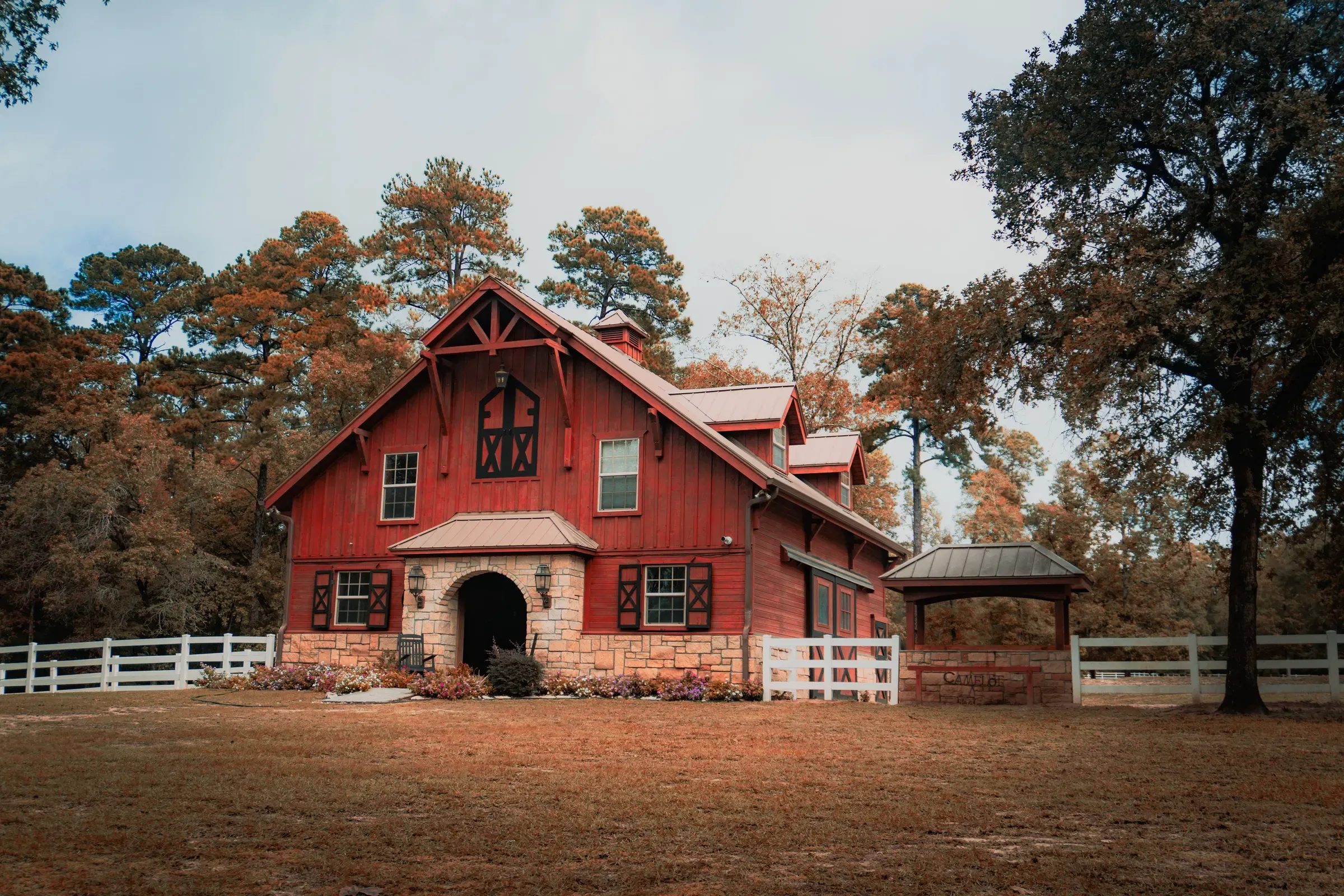

Barndominium and barn builders in Dripping Springs, Texas
Dripping Springs calls itself the Gateway to the Hill Country, and it has become one of the fastest-growing corners of it as Austin pushes west along US-290. It is also the Wedding Capital of Texas, so alongside barndominium homes there is real demand for event and guest barns. The catch is water: the city's extraterritorial water-quality rules and the Edwards Aquifer both shape what you can build here.
Quote requests from Dripping Springs go to one independent builder that builds across the Texas Hill Country and the San Antonio and Austin areas. Who does what.
Building around Dripping Springs
Dripping Springs sits in western Hays County along US-290, ringed by estate acreage, distilleries and breweries, and event venues, with Onion Creek and the Hamilton Pool area nearby. Buyers tend toward larger tracts and higher-end projects, often blending a home with a venue, guest quarters, or a shop. Growth from Austin has pushed land prices and expectations up, which shows in the finish level people ask for.
Barndominium builders in Dripping Springs, TX
Barndominiums and metal building homes lead, with a strong secondary market in event and guest barns tied to the local wedding-venue economy. Workshops and garages are common on the estate tracts.
Barndominium contractors in Dripping Springs are building at the high end: custom metal homes on estate acreage along US-290, often paired with an event barn or guest quarters for the wedding-venue trade. A general contractor here works inside the city's extraterritorial water-quality rules and, on some tracts, an Edwards Aquifer review, both of which shape the construction schedule before the first post goes in. Ask any turnkey builder how those two reviews are handled and priced, and whether the post-frame or steel shell is engineered for the ridge-top wind on the higher tracts.
Permitting in and around Dripping Springs
This is where Dripping Springs differs from the western towns. The City of Dripping Springs applies water-quality and impervious-cover requirements within its extraterritorial jurisdiction, not just inside city limits, because of the sensitive creeks and aquifer here. On top of that, much of the area is over the Edwards Aquifer contributing or recharge zone, which can require a TCEQ review before you disturb ground. Out in unincorporated Hays County you also need the septic permit. Check the Hays County permitting page and confirm your parcel with the city and county first.
Site notes for Dripping Springs land
Estate tracts here often sit over the contributing zone with thin soil over limestone. Plan on an aerobic septic unit, budget for a well drill, and engineer the building for a design wind of roughly 107 to 115 mph, more on exposed ground, using the exact value from the ASCE Hazard Tool.
What the city reviews on land in the Dripping Springs ETJ
The city's water quality ordinance (Article 22.05) applies to all property inside the city limits and in the extraterritorial jurisdiction, the band of land the city regulates outside its limits. It caps impervious cover, meaning roofs, paving and other hard surfaces, at 10 percent of the site over the Edwards Aquifer recharge zone and 35 percent over the contributing zone in the ETJ. Rainwater harvesting tanks do not count as impervious cover, though the roofs that feed them do. A single-family home that is not part of a subdivision needs structural water quality controls only if it goes over those limits, and caves, sinkholes, springs and other critical environmental features carry a 150-foot setback.
The city's site development rules (Article 28.04, amended November 2023) require a site development permit before work in the city or the ETJ, but they exempt single-family detached homes, unless they sit in a subdivision with private streets or a private amenity, and barns, sheds, livestock pens and other agricultural buildings for private use. The city requires a building permit in the ETJ only where a development agreement or other council approval calls for one. Its subdivision rules also reach the ETJ, except a division of land into parts larger than five acres where each part has access and no public improvement is dedicated. Creek buffers, which run from 50 feet on each side of the centerline of a creek draining more than 50 acres to 400 feet on each side of one draining more than 1,280 acres, are set when land is platted, so a lot platted before the ordinance took effect does not pick them up.
Taking land out of the ETJ
Since September 1, 2023, Local Government Code chapter 42, subchapter D (Senate Bill 2038) lets the owners of the majority in value of an area petition a city to release it from the ETJ. If the city does not act by the later of the 45th day or its next council meeting after the 30th day, the area is released by operation of law. The law does not apply to land that was voluntarily added to an ETJ in a county that grew by more than half in the 2020 census and has more than 240,000 people.
Dripping Springs has used it. On January 16, 2024 the city council voted 5 to 0 to release 14 properties from the ETJ, filed as Ordinance No. 2024-01. The staff memo in that meeting's packet notes that most requests the city receives are exempt because the land was voluntarily annexed into the ETJ. So before you count on leaving the city's water quality rules, find out how your tract came into the ETJ.
Water, sewer and power to a Dripping Springs tract
Dripping Springs Water Supply Corporation serves much of the area, and its new service page sends every new connection through the Hays Trinity Groundwater Conservation District first: a district Water Service Connection form and a separate $1,000 check to the district, and the meter goes in only after the district issues its Certificate of Confirmation. The corporation's fee table puts a standard home meter at $9,414 payable to the corporation: a capital contribution of $8,614 (effective January 1, 2025), $600 for the meter and installation (effective September 1, 2026), and $100 each for membership and inspection.
City sewer is not an option on most acreage. The city's wastewater system serves properties inside the city limits and customers in select subdivisions with development agreements, so a tract outside them plans on its own septic system.
Pedernales Electric Cooperative lists both Hays County and the City of Dripping Springs in its service area. Under its tariff (effective October 1, 2026), a home, a barn, a shop and a water well all fall under the same residential service section, and the applicant pays the full cost of extending service, per meter, before construction starts. A $200 system impact fee is added for each new service location, and service that is not permanent pays the whole cost of installing and later removing the line. There is no allowance that covers the first stretch of line, so price the distance from the nearest PEC line before you choose a building site on the tract.
Dripping Springs flood rules
The city's flood damage prevention ordinance (Article 22.08, adopted January 2025) applies to land with a mapped flood hazard area inside the city limits and in the ETJ, though the city may hand ETJ cases to the Hays County floodplain administrator. It uses the FEMA flood study and maps for Hays County effective January 17, 2025, and it requires the lowest floor of a new home to be elevated one foot or more over the base flood elevation. The city engineer administers it, so ask the city first which office will review your permit.
Get a free quote for your Dripping Springs project
Tell us about your project. Your details go to one independent builder, who can schedule a free consultation or quote. No cost, no obligation.
Thank you. Your request is in.
The builder will reach out about your project. You can also call (830) 272-7461.
Dripping Springs building questions
Can I build an event or guest barn in Dripping Springs?
It is a common project here given the venue economy, but check three things first: any deed restrictions, whether the land is in the city or its ETJ where water-quality rules apply, and the Edwards Aquifer status of the parcel. Commercial event use can add requirements. Confirm the specifics with the City of Dripping Springs and Hays County.
Do the water-quality rules apply if my land is outside the city?
They can. Dripping Springs applies water-quality requirements within its extraterritorial jurisdiction, which extends beyond the city limits. Confirm whether your specific parcel is affected, and what is required, directly with the City of Dripping Springs.
Who builds in Dripping Springs?
An independent local builder who works in Hays County and provides the quote.
Updated