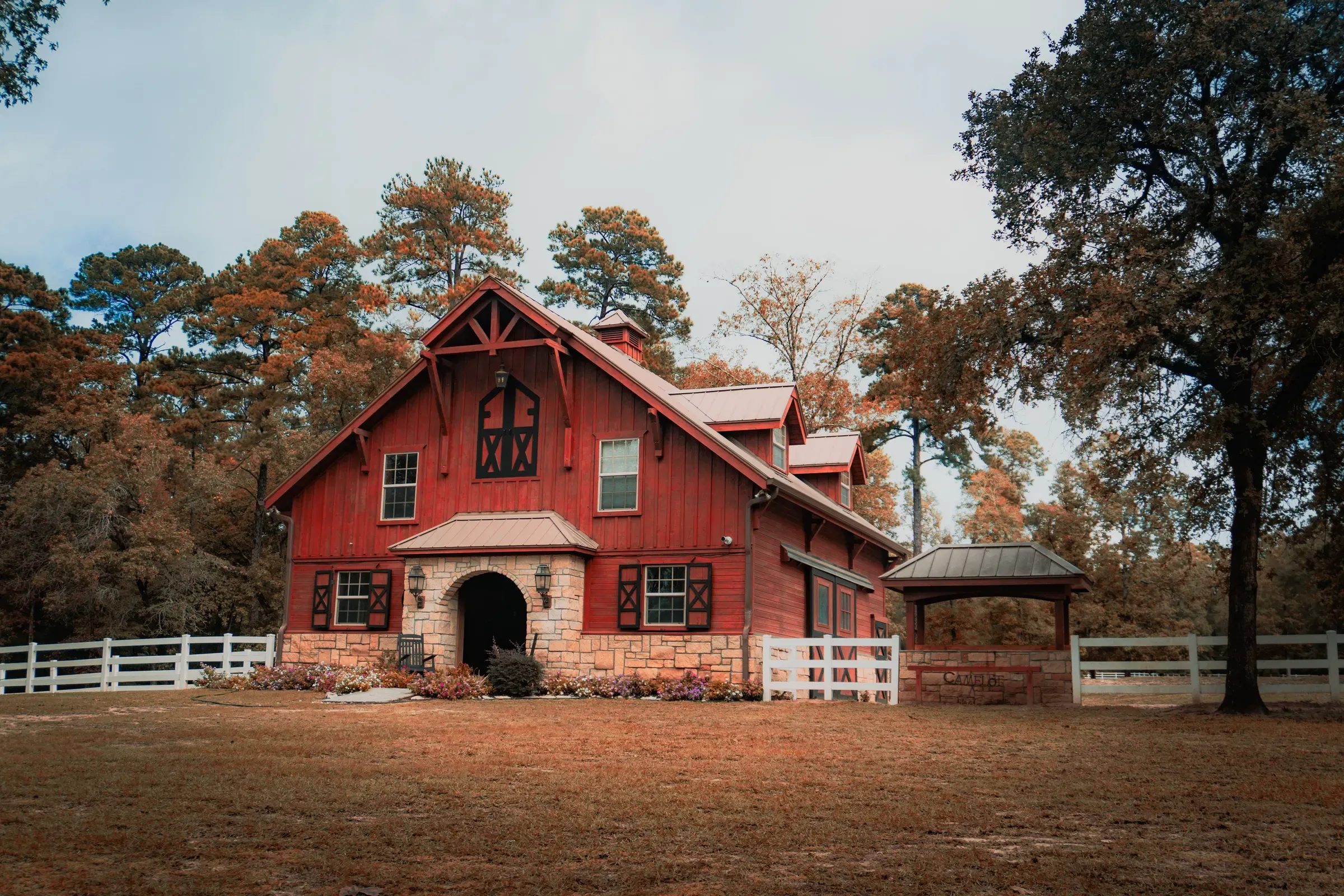

Barndominium and barn builders in Wimberley, Texas
Wimberley is a small, artsy Hill Country village in the Blanco River valley, beloved for Jacob's Well and Blue Hole. That same water is why building here comes with more environmental scrutiny than most places, and why septic siting and floodplain both deserve early attention. Barndominiums and guest barns on hill lots are the common build.
Quote requests from Wimberley go to one independent builder that builds across the Texas Hill Country and the San Antonio and Austin areas. Who does what.
Building around Wimberley
Wimberley sits in western Hays County where Cypress Creek meets the Blanco River, a village of artists, market days, and weekend visitors. Land is often hilly and wooded, with lots ranging from small village parcels to acreage in the surrounding valley. Buyers are frequently drawn by the setting and want a home that sits lightly on it, sometimes with guest quarters for family or visitors.
Barndominium builders in Wimberley, TX
Barndominiums and metal building homes lead, with guest barns and workshops common on the acreage. Practical, character-conscious builds suit the village more than oversized showpieces.
A barndominium contractor in Wimberley is building on hill lots in the Blanco River valley, where septic siting and floodplain get more scrutiny than almost anywhere else in our area because of Jacob's Well and the creek. Custom-built metal homes that sit lightly on a wooded lot, often with guest quarters, are the common project, and post-frame construction handles the slopes well. Ask a general contractor here where the septic system goes before you talk about floor plans, and get a turnkey quote that separates the building from the site work, which on a hill lot can be a large share of the total.
Permitting in and around Wimberley
Two local realities stand out. First, water quality: the springs and creeks here, including Jacob's Well (the headspring of Cypress Creek) make septic siting especially scrutinized, and much of the area sits over the Edwards Aquifer contributing zone that can trigger a TCEQ review. Second, floodplain: the Blanco River through Wimberley saw a deadly flash flood on May 24, 2015, cresting at 44.9 feet on the Wimberley gauge, more than 11 feet above the 1929 record of 33.3 feet, according to the National Weather Service. Building near the river brings floodplain requirements. Out in the county you also need the septic permit. See the Hays County permitting page.
Site notes for Wimberley land
Valley and hill lots here are thin soil over limestone with sensitive drainage. Plan an aerobic septic unit sited carefully away from creeks, keep out of the floodway near the Blanco River, and engineer for roughly 107 to 115 mph design wind, more on exposed hills, using the exact value from the ASCE Hazard Tool.
A house well near Wimberley: the Hays Trinity district rules
Groundwater in western Hays County is regulated by the Hays Trinity Groundwater Conservation District, which covers the county outside the Edwards Aquifer Authority, the Barton Springs district and the Plum Creek district. Its rules (amended effective November 2, 2023) require a well construction notification before any well is drilled, exempt or not. A well drilled and operated solely for household use, and built so it can pump no more than 25,000 gallons daily, is exempt from a drilling permit, and the rule sets no minimum tract size for it. One well can serve up to four single-family homes on the same or adjoining property as a shared domestic well. Household use there means the house, a lawn, a family garden or orchard, domestic animals, a pool for a single residence, and a stock pond only if it is under a quarter acre, averages less than three feet deep and is lined with bentonite, a geomembrane or an equivalent. The notification carries a property plat, the Hays County property ID and the fee, and the district's fee schedule (effective November 2, 2023) charges $1,000 for a new exempt well. Staff have at least three workdays to approve a complete notification, and the go-ahead to drill is good for 90 days, extendable to 270 days in all.
Placement comes from Rule 4.3. A well equipped for under 17.36 gallons a minute sits 150 feet from existing wells and 100 feet from adjacent property lines; the district can approve 50 feet from the line if the top 100 feet of the annular space is pressure cemented. Every new well also stays 50 feet from a septic tank, 100 feet from a drain field or wastewater irrigation area, and 150 feet from a livestock or poultry facility. On a small hill lot, draw the well, the tank and the drain field on one site plan before the barndominium footprint is fixed, since the 100-foot drain field gap often decides where everything else fits. The driller files the State of Texas Well Report with the district within 60 days of completing the well.
Jacob's Well, the drought stage and a well for a business
The district draws a Jacob's Well Groundwater Management Zone around the spring that feeds Cypress Creek through Woodcreek and Wimberley (Rule 15). Inside it, a new non-exempt well drilled on or after March 5, 2020 that pumps more than two acre-feet a year may not produce from the Middle Trinity (the Lower Glen Rose, Hensel and Cow Creek formations); it goes to the deeper Lower Trinity instead, cased and grouted from the surface down to the production zone. An exempt household well inside the zone must stay exempt and cannot be converted to a non-exempt use later. So a rental cabin court, event barn or other commercial use planned for later needs its water source settled before the first well goes in. Permitted wells in the zone cut pumping on the 10-day average flow at the USGS meter at Jacob's Well: 10 percent at 6 cubic feet per second or less, 20 percent at 5 and 30 percent at 3.
Drought rules reach the whole district. Under Rule 13, during the Critical or Emergency stage the district takes no new operating permit applications and allows no new well except a replacement for a permitted well or a well for exempt uses. The district's drought page, read October 18, 2026, posts the Emergency stage: a 40 percent curtailment district-wide and 30 percent in the Jacob's Well zone, and it reports a significant increase in dry wells and burnt-out well pumps. A household well can still be drilled under that stage. A well that needs an operating permit, which is any commercial or irrigation use, cannot be applied for until the stage eases, and an older well is worth having the driller check for depth and yield before closing on the land.
City water, the central sewer and the ETJ permit
Wimberley Water Supply Corporation's new service schedule (effective April 1, 2026) adds up to $7,288 for one 5/8-inch meter where a meter box is already in place: a $5,383 equity buy-in, $584 for meter installation, a $180 membership, a $75 customer service inspection, a $25 filing fee and the Hays Trinity district's $1,000 connection fee. Nearside taps, road cuts and road bores cost extra and are quoted before membership. The corporation's notice of September 9, 2025 says that adding a guest house, garage apartment, mobile home, recreational vehicle or any other habitable structure to a served property means a reclassified or additional service, with more equity buy-in, inspection and connection fees and a higher monthly base rate. The city's utilities page also lists Aqua Texas for water and Pedernales Electric Cooperative for power (its line terms are on the Dripping Springs page), so confirm which system holds the parcel.
The city owns one utility, the Central Wimberley Wastewater System. Its FY26 wastewater fee schedule sets a $50 non-refundable residential application, a $150 deposit and a $60 monthly base charge for a 3/4-inch line, and bills the tap at its full installation cost plus a 15 percent administrative fee, from an estimate by the city's engineer or contractor. The service agreement asks for proof of Wimberley Water Supply Corporation membership, bills usage off that meter, and limits each connection to one dwelling or one business. Outside the city limits, the city's ETJ development permit application (April 2022) asks for the disturbed acreage, impervious cover, the Edwards Aquifer zone, the FEMA floodplain designation, the water and wastewater source, and how the project meets Article 9.04, Water Quality Protection, of the city code. It wants a Hays Trinity sign-off where a well is proposed, and the owner pays the city's third-party engineering review fees.
Get a free quote for your Wimberley project
Tell us about your project. Your details go to one independent builder, who can schedule a free consultation or quote. No cost, no obligation.
Thank you. Your request is in.
The builder will reach out about your project. You can also call (830) 272-7461.
Wimberley building questions
Is septic harder to permit around Wimberley?
It can be more scrutinized, because Jacob's Well, Cypress Creek, and the aquifer make groundwater protection a priority here. Expect an aerobic system carefully sited away from water features, and confirm requirements with Hays County.
Can I build near the Blanco River in Wimberley?
Possibly, but the Blanco River had a deadly flash flood through Wimberley in May 2015, so riverside tracts carry floodplain and floodway restrictions that can limit where and how you build. Confirm the floodplain status of your parcel with Hays County before you plan.
Who builds in Wimberley?
An independent local builder who works in Hays County and provides the quote.
Updated